

Grenada’s Elections Predictions 2022
November 29, 2024
Progress or Propaganda? A Report Card on the Racial Reckoning
February 6, 2025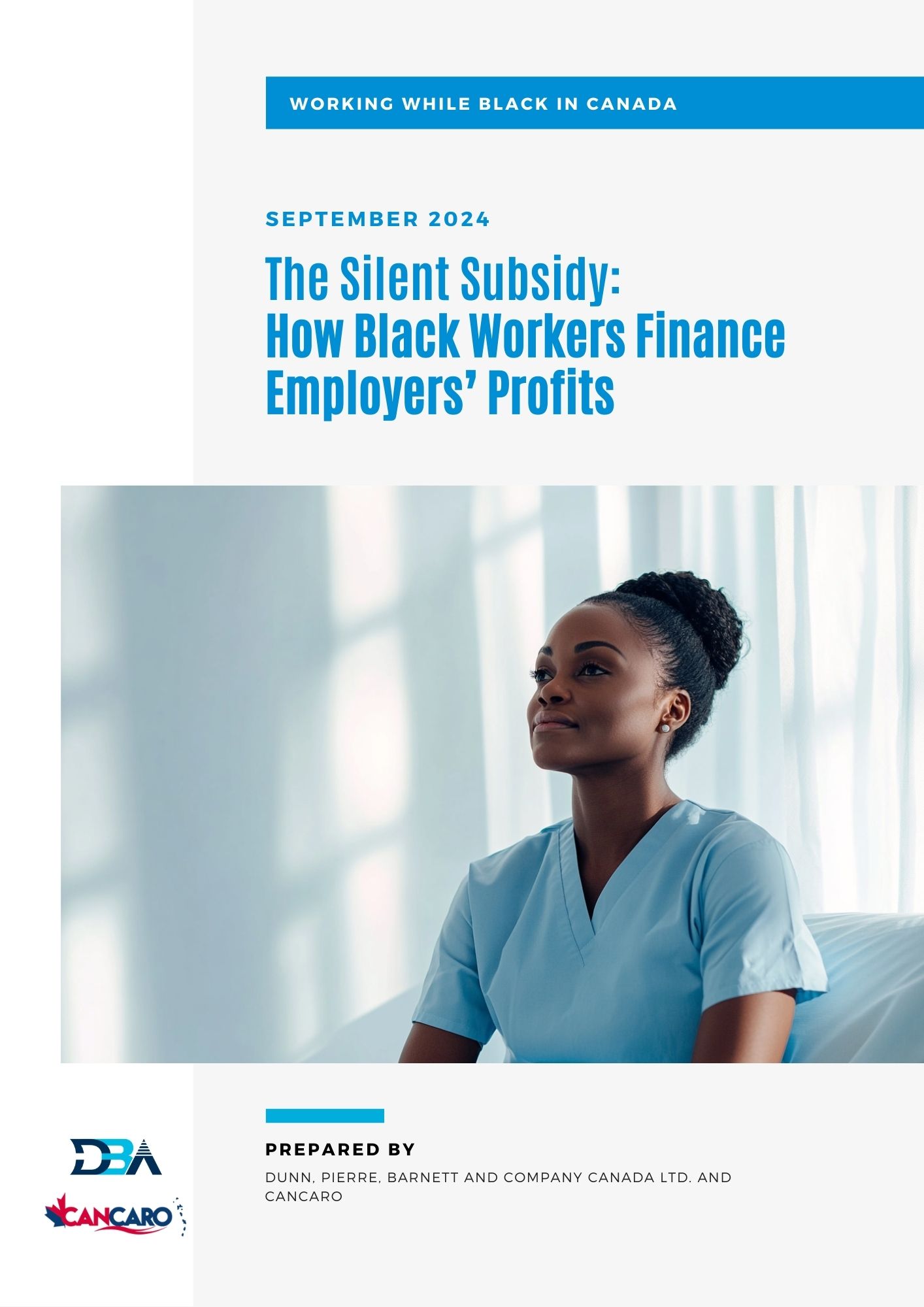
The Silent Subsidy: How Black Workers Finance Employers’ Profits
Research by Dunn Pierre Barnett and Canada Ltd., using data from Statistics Canada (Drolet, 2023), reveals a startling reality: Black Canadian women have been subsidizing the Canadian labour force by over $5 billion annually for the past 20 years. This massive subsidy arises from systemic pay disparities across industries despite accounting for factors like age, education level, job tenure, full-time status, location, parenthood, firm size, and union membership.
$49.99
Black Workers (especially health workers) are subsidising the Canadian Labour Force to $5 Billion Annually.
Research by Dunn Pierre Barnett and Canada Ltd., using data from Statistics Canada (Drolet, 2023), reveals a startling reality: Black Canadian women have been subsidizing the Canadian labour force by over $5 billion annually for the past 20 years. This massive subsidy arises from systemic pay disparities across industries despite accounting for factors like age, education level, job tenure, full-time status, location, parenthood, firm size, and union membership.
Disparities Across Industries
The research uncovered rampant pay gaps in over 42 industries, spanning both the public and private sectors, including banking, energy, and insurance. These disparities highlight the pervasive racial bias and discrimination that underpin the wage gaps between Black workers and their White counterparts.
For instance:
Health Care and Social Assistance: Black women, who represent 33% of the workforce in this sector, earn a median income of $42,000 compared to $54,000 for all Canadian men—a gap of 22%.
Retail Trade: In this sector, Black women earn $13,900 annually, while the median for all Canadian men is $29,600—a shocking 47% disparity.
Educational Services: Black women earn $38,800, which is only 65% of the $59,200 median income earned by all Canadian men.
Public Administration: Black women in this sector earn $58,000, compared to $79,000 for their male counterparts, reflecting a 27% gap.
Accommodation and Food Services: Black women earn $10,600, or 69% of the $15,400 median income for all Canadian men.
The Paycheque Penalty
These persistent gaps represent a “paycheque penalty” that effectively forces Black workers, especially Black women, to subsidize employers’ labour costs. Systemic underpayment results in significant economic losses for Black workers over their careers, depriving them of opportunities to build wealth and financial stability.
Sectoral Impact
The financial impact of these wage gaps is staggering. In the top five sectors where Black women are employed, the cumulative annual “subsidy” they provide is as follows:
Health Care and Social Assistance: $1.79 – $2.15 billion
Retail Trade: $512 – $616 million
Educational Services: $345 – $616 million
Public Administration: $307 – $416 million
Accommodation and Food Services: $119 – $143 million
These sectors alone account for a subsidy of $3.07 – $3.95 billion annually. When all sectors are considered, the total annual penalty rises to an astonishing $5.47 – $6.59 billion.
In Canada, racism is a profitable business
This $5 billion subsidy underscores the broader issue of systemic racial and gender inequities in Canada’s labour market. Despite the critical roles Black women play across sectors, their contributions are undervalued and undercompensated.
This impacts individual workers and limits the economic potential of the entire country by perpetuating inequality and reducing overall productivity.
To download the entire report.
You must be logged in to post a review.
Reviews
There are no reviews yet.